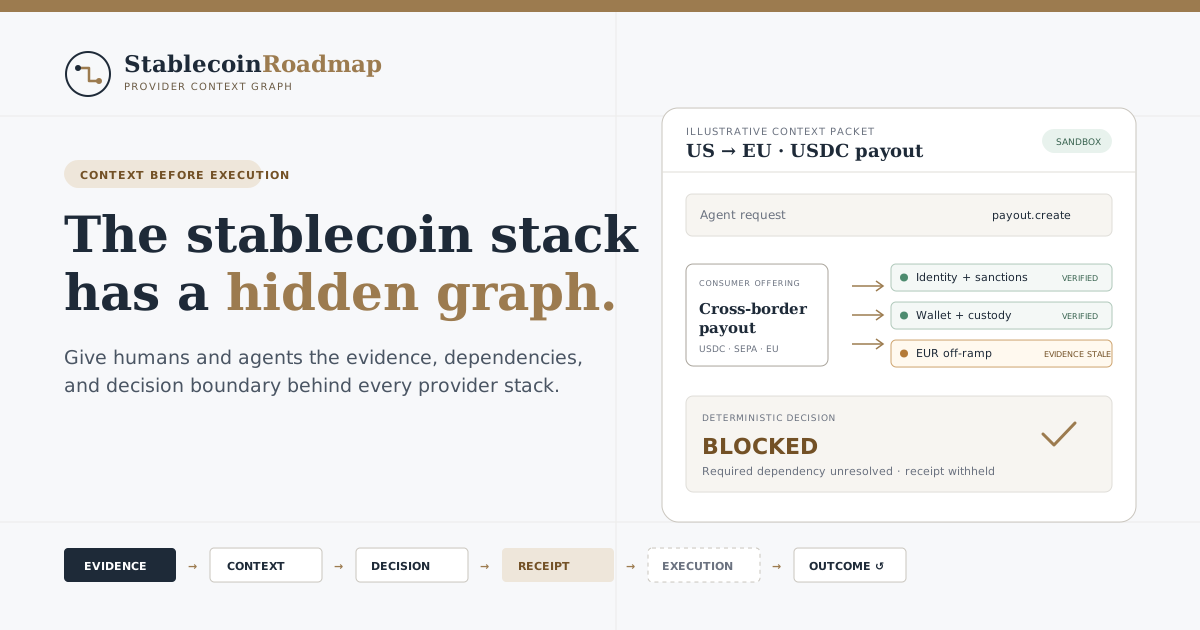
A stablecoin product can look simple from the outside. Underneath it sits a changing network of issuers, banks, custodians, wallet systems, compliance services, liquidity providers, blockchains, payment rails, and local payout partners. The visible provider is often only the first node.
That hidden network matters more as software agents move from answering questions to using tools and completing multi-step work. An agent can call an API quickly. Speed does not tell the agent whether the selected provider is authorized for the operation, whether a required supplier is available, or whether the supporting evidence is still current.
Agentic systems move the bottleneck
The agent ecosystem is converging on tools, persistent state, controlled execution environments, and observability. OpenAI describes current agent infrastructure in terms of tools, memory, sandboxed execution, and long-running work. Anthropic recommends simple, composable patterns with clear tool interfaces and feedback from the environment. LangChain calls the work of supplying the right information at the right step context engineering.
In stablecoin operations, context engineering cannot stop at prompt design. The context must include facts that the model cannot safely invent: legal entities, provider offerings, authorizations, jurisdiction limits, corridor support, assets, networks, rails, dependencies, evidence dates, adapter versions, and connection state.
The model can explain a decision. It must not manufacture the facts or override the gates that make the decision valid.
Connectivity is necessary. It is not context.
Large infrastructure platforms already make provider connectivity easier. The Fireblocks Network presents a broad provider directory and a network for connecting payment participants. Stripe presents Bridge and Privy as a connected stablecoin and wallet stack.
Stripe's own engineering account is especially useful. Stripe extended its existing payment graph with wallet nodes and stablecoin edges instead of building a parallel system. Bridge supplies custody and transaction services inside that operating path. The graph supports routing, liquidity movement, and reconciliation across fiat and stablecoin systems. Stripe describes that architecture here.
Provider Context Graph addresses a different question. It does not ask only, “Can these systems connect?” It asks, “What does this operation depend on, which facts support the stack, what fails if a dependency changes, and what evidence permits the next action?”
One canonical provider graph
The graph starts with the provider records that an operating team already needs: provider identity, legal entity, offering, authorization, eligibility, evidence, connection, adapter install, scorecard, and selection receipt. We do not create a second ontology for agents.
We add one missing relationship: a consumer offering can depend on a supplier offering. Each dependency has a defined operating category and criticality. Its scope can include environment, jurisdiction, corridor, asset, network, rail, validity dates, and evidence freshness.
PostgreSQL stores these relationships. Recursive queries compile the complete dependency closure. A separate graph database is not justified until measured query volume shows that PostgreSQL is insufficient.
Three layers over one model
- Provider Context Graph. Evidence and runtime observations update the canonical provider subjects and their relationships.
- Provider Stack Intelligence. One compiler assembles the applicable context. One deterministic evaluator returns
complete,degraded,blocked, orneeds_review. - Provider Control Plane. Supported execution accepts an immutable selection receipt. It does not accept an informal agent recommendation.
The context packet includes eligible offerings, dependency closure, authorization, eligibility, runtime readiness, evidence freshness, required failures, concentration exposure, compatible alternatives, and a deterministic context hash. The evaluator applies explicit rules to that packet.